
.png)



Cultivating Audacity: The Audacious Path To Success With Anne Marie Anderson

Ever wondered how to truly cultivate audacity in your life and career? Adam Markel dives deep with three-time Emmy Award-winning broadcaster, author, and keynote speaker Anne Marie Anderson, who shares her inspiring journey through decades of sports television. Discover how her book, Cultivating Audacity, empowers you to dismantle doubt, embrace calculated risks, and achieve success by focusing on actionable resilience and playing to your unique strengths. Anne Marie reveals how to reframe "failure" as valuable data, understand the power of "sports specialization" in business, and navigate the four common barriers to risk-taking: fear, time, money, and your inner critic, transforming them into catalysts for growth. This episode is a must-listen for anyone ready to make audacious moves and build a "front row" of trusted advisors to propel them forward.
ShowNotes:
04:42 - Resilience Redefined: Data, Not Failure In Athletics
09:34 - Cultivating Audacity: Dismantling Doubt And Letting Yourself Win
12:12 - From Producer To Broadcaster: Anne Marie's Competitive Spirit
19:07 - Shape-Shifting Leadership: Lessons From Phil Jackson
25:25 - Sports Specialization In Business: Playing To Your Strengths
33: 46 - Worth It Vs. Reckless Risks: The Front Row Advantage
38:54 - Embracing Imperfection: Anne Marie's First Live TV Experience
Get the newest Change Proof Podcast episode delivered directly to you – subscribe here.
And, if you’re enjoying the podcast, please give us a 5-star rating on iTunes! For instructions click here.
How do we leverage continuous uncertainty to thrive in this unprecedented new world?
The answer is to build the resilience we need to power us through the challenges we face so that we become “Change Proof.” Prepare to tackle the future with confidence by reading Adam’s latest book Change Proof: Leveraging the Power of Uncertainty to Build Long-Term Resilience.
Watch the episode here
Listen to the podcast here
Cultivating Audacity: The Audacious Path To Success With Anne Marie Anderson
I'm so excited for the guest and person that I have on the show. You're going to learn so much from her. You're going to love her. She's absolutely amazing. Here is her bio just. It's so impressive. It's so interesting. We're going to dig right in. Her name is Anne Marie Anderson and she is an Author, a three-time Emmy Award-Winning Broadcaster and Keynote Speaker.
Having spent more than three decades in sports television, Anderson has covered many of sports' biggest events, including six Olympic games, golf majors, NBA, and Major League Baseball playoffs, heavyweight title fights, and the Super Bowl for a variety of networks, including ESPN, ABC, Fox and NBC. She has been a keen observer of leadership styles in some of the most successful franchises in sport and studied how they can be applied to other industries. Her book, Cultivating Audacity, challenges readers to dismantle doubt and grow the skills to meet the challenges to excel. You are going to so love this conversation. Sit back, buckle up. Just get loose and enjoy.
Beyond The Bio: Anne Marie Anderson's Driving Curiosity
Anne Marie, so your bio, your history, all the things you've done in the world, it's incredible. It's impressive. It's a mouthful. It was fun to just read it, actually. My question to you at the outset is really, what's one thing? I'm sure there's a lot of things, but what is one thing that's not part of that standard CV introduction, all that good stuff for you that you would love for people to know about you?
I think the thing that really defines me that I would want people to know is that I'm incredibly curious about everything in the world. If we were to meet, I want to know not just your name, not what you do. In fact, I don't want to know what you do. I want to know what drives you, what excites you, maybe what challenges you? What's hard? I'm never really afraid of the hard. I'm interested in people's resilience. It's funny, you're wearing a shirt that says resilience. That's exactly what I'm interested in. It’s like, how did you overcome this? For anybody I meet. I think that's something that's not in any CV anywhere, but it is what defines and what excites me.
I would just want to riff on that for a minute because given how many moments of your life you've spent with people that are at the height of or they're involved in their athletic pursuits professionally and even at the Olympics on an amateur level, but they're after something this peak of performance and all that.
Lately, I really hear the word resilience used a lot. I wrote a book some years ago called Pivot, and then after the pandemic, or in the pandemic, all I heard was the word pivot. I wish I had a dime for every time people said that word. Resilience now, really similarly, being used a lot among athletes in describing how they're making it through various challenges in that pursuit. I'd love to just get your take on that. How have you seen resilience show up in that arena in the athletic space, and how would you even define it, I guess is also what I'd like to know.
Resilience Redefined: Data, Not Failure In Athletics
One of the things that's happened in my life as I’ve just matured and dug into audacity, that's my thing, is that I don't define anything as a failure anymore. There is no such thing as failure for me. It's all data leading me towards the next thing. When you're working with athletes, they don't succeed far more than they succeed. You miss more shots than you take. One of the things I’ve really enjoyed in 36 years of working in sports is watching the response.
I think resilience is, a lot of times, about the response. It is how do you take something that did not turn out the way that you hoped, that you intended, that you planned? How do you take that and turn it into your next move? To me, that's resilience. That can be if you're on a basketball court and you make the wrong move and your defender gets you, on the next time down the court, how do you respond to that? It's the same thing in life. If you are rejected for a job or in a relationship, your relationship fails, what's your next move after that? That, for me, is resilience. The fact that you get up and you make another move.
That's so funny because even the concept for Pivot, for that book was the idea of the pivot in basketball. You can move in a circle around that foot that is stationary to be able to see you can go 360 degrees around to be able to see what your options are so that you can make that next move. I think when people define resilience, because as a researcher, as a speaker myself and in our business side, the Workwell side of our consulting, we're asking that question. We're getting people's take on it. We're analyzing the data, like you said, a lot.
People often equate it very much to this ability to bounce back or take a punch, take a hit, Rocky, grit, even that idea that you have to just be able to withstand those blows. To me, that's so not the story. The side of the story that is burying the lead. You're a journalist. I feel like that's what you just said, that to do that is very much like it is not assertive. It's almost leans into a victim. You become a punching bag if you don't learn something to be able to actually make your next move.
To just take it, it's just not productive. To just absorb it. You're in the same spot and you're open to like another attack. I'm not a big fan of the word hope, and I know it's an unpopular take. People say it's a virtue, but for me, it's not a plan. It's not actionable. I feel like resilience is actionable. It is something where, here's what happened and how am I going to respond?
I love when you're talking about like a basketball pivot. You're seeing every single option around. Your next move also may not end up the way you want it to, but now you've got even more data. “This doesn't work this way, this doesn't work this way, so let's try something else. That doesn't give me the outcome that I want.” I agree because resilience as a matter of like, “I can take a shot and get back up again,” to what? To receive another shot or to actually take a step and make any move?
Do you remember that when we were kids, I'm assuming we all had these things, the blow-up clown that you would punch? It would hit the ground and then it would just bounce right back up. Punch a dummy. It's a good visual. Nobody would ever want to think of themselves in that way. I think it really requires not just a reframing, but changing a language and recognizing that language actually really is important in how we see things.That is why you write books and why people still, some of them, read books. You've got a book. I want to learn more about it. I want people to learn more about it. I want to know, first and foremost, what inspired you to do that? You've got in the background. I’ll just describe it. There are three statues sitting over Anne Marie's left shoulder. There are three statues that anybody in the entertainment industry and business would want to have, they strive to have. These are really beautiful gold statues. They're Emmys. I want to understand, from your perspective, in a storied career, where does writing a book fit in? What was your inspiration for doing that? Let's get to the through line of what that book is all about as well.
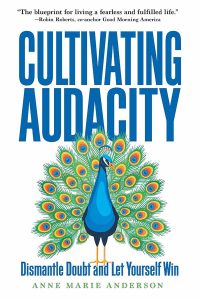
Cultivating Audacity: Dismantle Doubt And Let Yourself Win
Thank you. The book is called Cultivating Audacity: Dismantle Doubt and Let Yourself Win. It was interesting to me, Adam, as I was writing it, because I wanted to call it How to Dismantle Doubt and Take Bold Risks, because that's what audacity is. It's the willingness to take bold, sometimes surprising risks. What we found out when we tested the title was that people were afraid of the word risk, just the word in the title. They were like, “I don't want to take a risk,” because there was this attachment to failure.
It was interesting. I acquiesced and changed it to Let Yourself Win. I'm mad I did, in a way, because I want people to get comfortable with that word risk. The reason that, throughout my career, I’ve spent 36 years in television, that I'm still working broadcaster is television is so rejection-heavy. I was so thin-skinned that I needed to recalibrate my relationship to other people's opinions of me and other people's ideas of success, especially when I made the move to go in front of the camera.
I started out as a producer. My career ended up being taking one bold risk after another. It's interesting with our earlier conversation about taking the hit and getting back up, because certainly, on television, in the public forum, you can just get hit again and again with people's opinions from their couch, from their mother's basement, through their thumbs or whatever.
For me, I ended up blocking out those people because their opinion doesn't matter to me. I kept thinking about how can I be better? How can I risk more? At this point in my career, I wanted to share with people, because I had so many people, and you have this too, where people come up and they say, “I want to do what you do. I want to do that, but I'm afraid, but I don't have time, but I don't have talent, but I don't have money.”
I wanted people to understand that there's four barriers that I’ve seen consistently that get in the way. Fear, time, money, or your inner critic. Those stop people from taking that risk. I wanted to share with people those four barriers and some ideas about how to attack them, how to use them, not overcome them. I don't think that you overcome your fears. I think you need to be curious about it, make friends with it, and use it to propel you forward to your next move.
Curiosity, just something you were like that curious kid that was always getting in, like Curious George getting in trouble. Where did curiosity start to be cultivated in you? Is this just a thing that evolved as you began to evolve?
From Producer To Broadcaster: Anne Marie's Competitive Spirit
I think the curiosity came throughout my journalism career where I would get to meet people and athletes. Obviously, the best athletes in the world. I’ve covered six Olympic games and the Super Bowl and heavyweight title fights and NBA playoffs and all that. Being able to do those interviews for Sports Center, for ESPN where you're finding out what makes these particular people tick. I think the thing that defined me in terms of audacity, the thing I was born with, because I don't think it was curiosity or the thing I grew up with is a competitiveness with myself.
I am the youngest of five. I have four older brothers. I was constantly trying to keep up with them and I felt like I just needed to have a place. It was tough to have a place with brothers that were so much bigger and older. I feel like that's where my competitiveness came from, which has served me really well in my career, for sure.
I don't have any real-life experience to back this up, but I have three daughters and a wife and a son too. This is my whatever the credentials are for this statement. It's a male-dominated industry. It has been and still is. For you to break through and succeed in that space, I would imagine, yeah, a healthy competitive spirit would probably help you, right?
Yeah, absolutely. I do thank my brothers for the fact that I am so comfortable in competitive spaces. I'm comfortable with men. There's a lot more women obviously now in the industry than there were in 1989 when I started at ESPN. I started really young. I think I was just comfortable in a male culture, which has now become more of a gender-neutral culture, thank goodness.
That seems to be the case, for sure. Still work to be done there, obviously.
I always have to say this. When we talk about more work to be done, I always want to say like, because now we have seen more people of color in television and more women, but the one area we haven't seen yet, we don't see people who are differently abled very often on television yet. I always want to put that out there and say, “Have you thought about that? There are people who are differently abled that we don't see on television yet.” I think that's the next big frontier.

Is it okay to celebrate the fact that great strides have been made in the right direction?
Of course.
I'm only saying that I'm teeing it up for the purpose that I think sometimes, it does feel as though we don't acknowledge some of the strides that are made because we're still saying, it's not right and it's not enough and it's not whatever. You're smiling in agreement with that.
I am. I'm nodding and smiling because at one point in the book, towards the end, I talk about these contemplation seas where when you've made the move, you need to think about it. One of them is celebrating. That's why I am smiling, because I think a lot of times, we want to celebrate when we get to the end and there is no end. I'm right with you, yes. Celebrating that we're here. Of course, there's work to be done.
It's the same thing when we're making that audacious move. I think in the book, I talked about I climbed to Everest base camp many years ago, pre-kids. I didn't just celebrate when I got to base camp at 17,000 feet. Every day was a celebration for what had been accomplished. That's why the big smile. Absolutely. We celebrate every step of the way. When people make a decision, by the way, an uncomfortable, audacious decision, you celebrate that. Not attached to the outcome. The actual win in audacity is in the action. It's not in the outcome. Celebrate that every single time.
Beyond Gender: A Vision For Inclusivity In Sports Broadcasting
I want to come back to audacity and get a little more granular on that in a second, but I do want to ask you what I feel like is a difficult question about the subject work we've been on for a moment, which is to say, what would be a sign to you? Let's just make it for the moment about women, because there's a lot of people that have been marginalized. I think if you have a heart and you have children, being a parent, I think that's grown my heart. I don't know if it does for everybody. I say this in the context of if you had a child that had a disability or was differently abled or was whatever.
You may have adopted a child, you would never want to think or see a world or live in a world where that child had a more difficult time to succeed than some other person's child who looked differently. I really think you could say that to the biggest bigot in the world and they still wouldn't be able to argue that fact. I want to get in that debate, but I don't get into those spaces on purpose, especially when it's at a distance because when people don't have to look you in the eye and speak face to face, they could say whatever they want. Another shop, another topic. What would be a sign to you that things are in a good harmony from the standpoint of women in the industry that you've been involved in for 30-plus years?
When we stop saying it's women, when it's all just people. When you talk about basketball, in my house, they say women's or men's. We're going to watch basketball game. Women's or men's, understanding that that's not the way it is in the rest of the world. At some point when we drop, “She's a tremendous female broadcaster,” or, “She's a tremendous female basketball player, she's a basketball player,” am I saying that she is the same talent that LeBron James is? No. Obviously, they have different skills, but when we stop calling them women basketball players, women play-by-play announcers, female officials, that's when I'm going to celebrate it a little extra hard.
This is not the show for the conversation, but I don't want to just put a marker here for people to give this some thought. This is one of those in life, I think the older you get, and I'm a little older these days than I was, so there's a lot of nuances. I think the greatest thing about life is that there's just so many riddles, so many paradoxes. I was raised at a generation where we were being brought up, at least a lot of my peers, to not see differences. That was our thing. Don't see differences. Gender, race, color. That's what we were striving for.
All of a sudden, we move into a period in the last ten or so years or more, we're going should really see that. We should be seeing people in their diversity, etc. It's like, what a fine line between seeing something because I think the way you're describing it is we're not seeing it because why would we point that out? An athlete's an athlete. A performer or a great broadcaster, or a great person in business is a great person in business, not a great woman in business. It is a fine line and I'm only saying it there to express my own view on it. I think it is one of those things we got to chew on a little bit.
Shape-Shifting Leadership: Lessons From Phil Jackson
For sure, Adam. It's interesting. For your audience, a business audience, one of the things that I’ve observed amongst great leaders in sports. The reason I use the word audacity is because that's what I’ve seen amongst the very elite, this willingness to take bold risks. One of the ways that they lead audaciously that's different is what I call a shape-shifting leader. They are seeing the differences and they are leading according to those differences. The best example I have always is Phil Jackson. I don't know, did you happen to see The Last Dance during COVID?
I did. By the way, and I'm going to declare this out loud, I am a dyed-in-the-wool Knicks fan. It's been painful. I was very young the last time they won the last game of the season. Phil Jackson was a New York Knick, and then unfortunately, he became the coach of what I think is the greatest team of all time, which was the Chicago Bulls and their threepeats. Phil Jackson's a genius.
He's a shape-shifting leader. What we saw in that docu-series, I saw it every day, but it's something that the worst of the world's seen, is how he worked with Dennis Rodman differently than he did with Michael Jordan. Michael Jordan was not allowed to go to Vegas in the middle of the season for a vacation but he allowed Dennis Rodman to do that, recognizing that Rodman did not need basketball. That wasn't Rodman's identity. That isn't what drove him. If he needed to have some time to blow off steam and to get himself together, great, because the Bulls needed him as the best rebounder in the game to reach their goal.
Jackson, as a leader, was so focused on the one goal and leaving anything that did not interfere with that out of the equation. I think a shape-shifting leader in today's society is really accomplished at seeing here's what drives this person, here's what motivates this one, here's the strengths of this one. They're able to lead and adjust their leadership style according to the strengths, needs, and abilities of those that they're leading.

You're probably too young to have been around to be at the point in your career to interview him or did you? Did you get to interview him while they were on one of their threepeat runs?
Yeah. I started ESPN in ‘89. I was around for all of that. If you remember at the end, after they won the championship, Phil Jackson retired from basketball forever until the Lakers came at him with a $30 million offer and he unretired and came to LA. I was LA bureau producer at that point. The reason that he came here is because the Lakers had a problem. The problem was the relationship between Kobe and Shaq.
I was there at the forum for Kobe's first day of practice and Dell Harris arranged the Lakers offense around Kobe, who was an incredible scorer. That caused a lot of friction. Watching Phil Jackson step into that franchise and make adjustments and dial back Kobe's offense. First of all, he changed it to the triangle offense and pushed Shaq forward and get the ball to him more. Watching him manipulate, manipulate sounds in in a negative way, but I mean it in a positive way, this group to get the most out of all of them was absolutely masterful. I spent a lot of time interviewing and a lot of time in that locker room as well, watching that dynamic change under the guidance of Phil Jackson.
I'm sure the people who are out there that are sports fans, and not everybody is, of course, but there are great analogies. There are great business examples that come from sports. We can stay on basketball, but I want to say at this point in my life, I'm like an obsessive golfer. It's not that I spend every day on the course, because I don't, but I do practice and I do find time to think about the game. It's very much a process game. I think mentally, how you can improve in that game is by really dialing the process in.
I know you covered the PGA as well. I want to get a sense of whether it's in golf or it's in some other sport, what are some of the things that you just think are tried and true lessons in sport that apply to succeeding as a leader in business? Nowadays, business is really challenging in a number of ways. I’ve got a new book that's coming out that's all about this cultural shift from the cultures that went into the pandemic to the cultures that organizations ended up with after the pandemic.
There's this thing that's going on that is a result of that event, but then there's also this massive demographic shift from Baby Boomers and Gen Xers that were running things and still, to some degree, are running things to Millennials and Gen Zs that are for sure by 2030, two-thirds of the workforce and all that thing. There are communication issues, there's intergenerational stuff, there are other challenges to the space, including just a lot of uncertainty given what's happening in the markets and politically, geopolitically, etc. That's a lot.
Are there some lessons that we can pull out of sport? Sport is wonderful in the sense that it's almost the same. Forgetting all the money and stuff, but baseball in Willie May's day and baseball in Aaron Judge's day, it's still the same game, essentially. What are some of those lessons that we might be able to look at for business leaders?
Sports Specialization In Business: Playing To Your Strengths
One of the things that I’ve noticed going through is, there used to be this idea of being like a well-rounded. Be a well-rounded person, work on your weaknesses. I have seen that less and less, and certainly with sports, there's specialization. Now this does not apply to golf. Yes, I did cover golf and you have to be great. Your short game has to be great. I loved watching the intentionality, but in other sports, there tends to be this focus on playing to your strengths.
I think in business and in leading that, again, it's part of a shape-shifting leader is recognizing what your strength is and then hiring the people who have different strengths to balance you out. I think it's far less frustrating now for the generations that are just starting their work career when they know that they can work on their strengths and their skills.
They're not a well-rounded generation because that's not the way that they necessarily grew up. Being able to sports specialize, if you will in business, is a terrific thing. My ex-husband is an accountant and you think of an accountant, you think of somebody very quiet, he's a partner in a firm, but he's the gregarious, outgoing guy. He's the one who goes out and gets the clients. He's not the one who is credits and debits.
I think just even watching him in his career over the last 30 years, watching how that has shifted where people have said, “Here's the strength of this particular person and that's a skillset we don't have. Let's let him do that and we will get other people to do this.” I think you see that in sports a bunch. Sad to say, Adam, you’ve got to complete your entire golf game. Every bit of it is all you, but other sports, for sure.
I love that. Have you used that term before, sports specialize in business or is that something that just came up for you?
That just came up for me.
I love that. Anne Marie. That's a repeat, I think. I'm going to borrow it and I'm going to give you credit. This idea of sports specialize in business because yeah, if you imagine in business, let's say, the equivalent of I can't hit a three-point shot, would you be taking three-point shots or would you put somebody on the team who can drain three-point shots? If you're great down in the post, you ought to be playing down in the post and they ought to be getting you the ball in the post to be a beast down there.
That isn't the way we thought 30 years ago. It was, you got to work on being well-rounded and I love that there's been this change now throughout business and yeah, it aligns with sport. Do what you're good at.
What if somebody says, “Maybe I'm the jack of all trades,” or, “I'm not really great at any one thing. I'm okay at a bunch of them?” I know that's just like setting up these naysay or the skeptic. I think there's something to address there as well, because a lot of people don't have Kobe skills. Almost everybody. I think in your life, in your world, it's very important to figure out what you are quite good at, what you're curious about, and honestly, what you're willing to devote time to.
I’ll use this as the analogy. Golf is a really difficult sport. Other than maybe Tiger Woods who at two years old or whatever is on the Merv Griffin show or whatever, he is putting and stuff like that. That's prodigy stuff but it's also process because he was trained from that point earlier, even, to do what he has been able to do. I think because it's so unnatural to just pick up metal stick and hit a little tiny ball and try to get into a hole. It's ridiculous.
The way you go about making incremental improvement is through a process that will help you to allow your actual talents to come through. Here's my motivational speech for the second. We're all so much more talented than we realize. We're often the ones that are the least aware of what we're truly capable of and what our genuine gifts are than even other people might be aware around us. Our challenges between the years, but process I think is super helpful.
When you look at Simone Biles as an example, what a great example she set for so many people and it was controversial. I'm glad we can talk about this for a second. I want to get your beat on this. When she took herself out of the Olympics two Olympics ago now because mentally, she just wasn't feeling ready. There was a lot of debate around that. I thought that was so brilliant that she put herself first and then understood what it would take for her to get back to a space where she could actually perform at her best. Do you agree with that?
Yeah, I do. I think there's this idea in both sport and business that everybody needs to be a starter. Everybody needs to be a star. If you're not the starter, if you're not the star, you're not performing, you're not contributing in the way and that's not what it is. There is a bench of players who come in at the right time and do the right things to help propel the team forward. You don't always know their name.
I think as a leader, you need to make sure that you feel that. First of all, have your bench invested in the outcome. Your bench has to be invested in the success of your product and they have to know their value no matter what the skill is. I think great leaders do that. That's one of the things, as you were talking about. I feel like there's this idea that everybody has to be a super producer and they don't. Everybody has to have a value in there.
For Simone Biles, in terms of taking the time, God bless her, she really showed people that it's okay to have that burnout, have that moment, step back, and take care of herself, which is an entirely different conversation, really, in business. It’s making sure that when you are not at your best, when you just can't, that you have the space and grace to be able to say, “I can't right now.”
As you say, it's a different conversation. The work that we do in the world is looking at organizations where there's a lot of burnouts that people are not even aware is happening. It's really very much under the surface. Yet, of course, the statistics, Gallup and so many other organizations that are researching this are saying to us how much anxiety there is, how much issues in terms of people's engagement, etc., are falling off a cliff. In part, I think it's because they're not willing to or it's not okay. There's not permission to do what Simone did, to find that place, space, and grace to be able to take better care of yourself.
I sometimes say this to an audience. If you had an Olympic event tomorrow, would you have been doing what you've been doing for the last month, the last week, the last day in terms of what you eat and what you drink and how you sleep and how you care for yourself mentally, emotionally, etc. It's like, are you kidding? No. These are multi-billion-dollar organizations that have a tremendous ripple effect on people's lives. We don't treat it with the same intentionality or care that we treat an athletic pursuit, whether it's team sport or an individual one. That is really interesting.
Back to audacity for a second, and this maybe is the way we land the plane here too. When I observe leaders and organizations, if I was going to pick out one thing other than this well-being thing which we will get into at the moment, it being an extraction model as opposed to something that's more nurturing. If there's one thing that I notice over and over again, it's that people don't make enough mistakes. In resilience, like you, I define it in that sense of when we know what doesn't work, we learn what does work.
You cannot learn what does work until you understand at a visceral level what doesn't work, which means you must make mistakes. Yet, it's as if everybody's trying to get through life making the fewest mistakes possible. On that side of audacity, how do you tell a leader that's being judged by a board of directors or is in that structure where that's the judge or the marketplace the public shareholders of the marketplace for that judgment. How do you tell people, or what's the context in which you say, “You’ve got to take more risks and make more mistakes?” It's great to say it from a stage and a keynote, but I just want to understand your perspective on making that real.
Worth It Vs. Reckless Risks: The Front Row Advantage
There's a couple of different kinds of mistakes. There are risks that are worth it and risks that are reckless. A great part of being audacious, an incredibly critical part is deciding which is which. In order to do that, one of the key components, and there's so much in the book in terms of how to do this, but I’ll give you one part of it, is having and creating a front row. Your front row are people who also are risk takers in their own path.

They don't even have to be in your same area of business or scope. These are the people who opinions you do trust, whose advice you will take because they have your best interest at heart without anything. For example, if you are a CEO of a company, it might be a CEO of a different company who understands the pressures that you are in where you can talk with them about worth it and reckless risks.
I’ll tell you who's not in your front row, Adam. Your mom is not in your front row. Your best friend is not in your front row because they want you to be safe. Audacity and success in business is not about being safe. It is about taking smart worth it risks that are carefully evaluated. To have a front row of people who will push you, pick you up, challenge you, tell you the truth is absolutely essential.
I want to just contribute because you're inspiring me to just want to have a conversation with you, which is what I love about doing this show. I think I said that to you right before we hit record anyway. I want to contribute my piece to that as well, which is to say on that mistaking figuring out what's a worth it mistake versus one that is reckless. I think it also has to do with whether you're trying to be a perfectionist.
I see a lot of leaders and a lot of people that work who are trying to achieve something that feel like they're trying to do it perfectly or they're requiring other people around them. You're shaking your head. I want to get your thoughts on that to do it perfectly. Why does that not work, do you think?
If you're putting pressure on people to do it perfectly, then you have effectively absolutely shut down any ability to take risks because there is this moment of like, “I better quit while I'm ahead,” which you will never hear a great leader say, ever. “I will quit while I'm ahead.” It's never about that. The pressure to do things perfectly, if you are not failing sometimes, you are not pushing enough for the risks. How big is the fail? I always talk about, “You're going to take this leap. Pack your parachute.”
I explain the parachute that I'm talking about is not something you can pull the rip cord and bail. It is to help you have a softer landing. If you are going to not succeed, that's my alternative for the word fail, with this particular challenge, what is your landing going to look like? If you're pushing all your chips in, and it makes me crazy when people say, “I'm going to start my business, I'm going to push it all in,” that's not wise. That's not a worth it type of risk. Evaluating how soft can you make your landing if it doesn't work out the way that you intend the first time so that you have enough left to make a second swing.
I think that it's the resilience there that really matters so much because this idea of not making mistakes, our research, it's the contrary that the most resilient people, teams, organizations are the ones that have made more mistakes, not less. On some level, they've been willing to take more risks. The last thing I just say on that is that if it's not perfectionism, because you've done this so naturally, I understand at least partly why you've been such a great broadcaster because, even if you point out what the issue is, you've got to show a solution if there is one, if you can point to one. Otherwise, it's like, what do we do with that?
If it's not perfectionism, then what is it? I think it's impeccability, which is a different concept because to be impeccable means that, to me, you are fully committed. There's full commitment just like in golf. They sometimes say this, that that wasn't a committed shot and that's why it ended up in the drink or wherever it is. That full commitment in the present moment is mutually exclusive with, let's say, multitasking or trying to avoid making a mistake. That's where putts don't fall and free throws hit off the back iron because somebody's trying to not lose. You never, ever create success. Try to succeed so hard that you're certain of missing it. You’ve got to be more loose than that.
It's about giving yourself a little bit of grace, too. It's interesting because, on one side, I'm talking about push and take these risks and do that. On the other side, I'm talking about giving yourself grace if it doesn't turn out the way you want the first time.
It will likely not, if we're being truly honest about it. We'll do this on a part two of this episode, but I'm sure you didn't just get into the seat at ESPN. Good, I love it. It took you a minute. You probably screwed up. You probably heard no a bunch of times.
Embracing Imperfection: Anne Marie's First Live TV Experience
My first time on live television, because I was a producer first, I was supposed to be a sideline reporter on a little regional football game like in the Mountain West. Somebody was unavailable. I got put on their games and my very first time ever on live television was in 78 million homes on ESPN 2. I was outside Virginia Tech Stadium in Blacksburg, Virginia. I think they were playing Ohio State College football opening weekend, sobbing before going on ESPN 2, just what you want in your reporter, just absolutely paralyzed with fear. I was afraid of what? Being bad, failing, being embarrassed, being judged. It was horrific. I went on the air, thanks to some encouragement and there's some words to that story, went on the air and I was bad and embarrassed and judged, but I survived it.
Of course I wasn't going to be good the first time, but my husband at the time said, “Anne Marie, what's the worst that can happen?” I always hate that question. I was like, “What's the worst? I could be so bad on air.” This is what I was telling Matt. “I can be so bad on air that not only will I never be on air again, but I’ll lose my producing job because people won't listen to me when they see that I won't be able to do.”
I could lose my entire career in television over this one risk that I'm making. I was telling my husband, “If I lose my career in television, I will be a miserable person and you will have no choice but to leave me because I won't be able to be a good mother to our kids who haven't even been born yet. Without a family and without a career, I could destitute and alone.”
That's Dan Harris's thing from his book 10% Happier. It's like, “I'm in Duluth and I'm destitute and then I die.”
Anything short of dying destitute alone is a success by that measure. I was bad on air. Okay, I survived. I got up the next week and went on again, and guess what? I was almost just as bad, maybe one half of 1% better. What it takes to be audacious is to be willing to face that, to get comfortable when you're not looking so great and try and try again. That's it.

Let's leave it there. I think it's fair to say that if you wake up or throughout your day, you don't have any moments when you get butterflies, if there's no nervousness or no nervous energy. I don't care who it is. It could be Shaq. Pick anybody in any sport, for example. If they were great at it, and I don't believe they would ever say that they showed up to those games or to those opportunities without that feeling because they had a pulse. It was important to them and they were on their growth edge.
I think a lot of times, when we're not in that scenario, like you're in your job, you're in your role, whether it's a top spot or at some other spot, if you're not feeling some nervousness around something, then you're probably not on your growth edge. That's its own version of playing it safe or its own version of mediocrity even.
I completely concur. People always say like, “Get out of your comfort zone.” I don't love the phrase, but it is how have you challenged yourself? How have you forgiven yourself? How have you tried something that seems just a little bit implausible? I like the surprise element of audacity.
I love it. Say the name of the book again. I want certainly people to get out there and grab their copy of this.
Thank you. It's called Cultivating Audacity: Dismantle Doubt and Let Yourself Win. For your readers, if they're curious, you can get the first chapter of Cultivating Audacity free at to www.CultivatingAudacity.com. That way, you can check it out, see what you think, and then if you like it, get the rest of the book.
Anne Marie, such a great opportunity to just get to know one another and have a conversation for everybody else's benefit. I really feel just better for having met you. Thank you so much.
Thank you, Adam. I enjoyed the conversation immensely.
---
Anne Marie is a powerhouse. I absolutely loved the tone of her voice. Clearly, being a broadcaster for so long, that was the obvious. The way her mind works, she's just quite brilliant and looking at things in a different way. Not just intelligent but intuitive. I was listening to her answer these questions and none of that was planned. Just so you know, some shows, I think, they map out a bit of an agenda. They have some things. Of course, anybody that's had any media training knows that in some instances, the guest shows up having already provided you with the questions like, “This is the roadmap to have me be successful in being interviewed on a show,” that kind thing. We just don't do that.
We don't accept questions ahead of time. We won't play from a scripted piece of music. We're much more jazz oriented in that respect. For the most part, I just find it more interesting for me to follow the breadcrumbs and see where they lead. I know that that's what creates more a synergy and energy between myself and the guest. Therefore, it's more interesting for us. It's got to be more interesting for you.
I hope that's the case, but of course you can always let me know if it's otherwise. There's a lot here I think that bears repeating. I'm not going to do that now. I think this is one of those episodes that you go back to. You share it with a friend, a colleague, family member, etc. I think there's a lot of Anne Marie’s wisdom. I hardly ever pitch this this way, but Cultivating Audacity, her book, I think is an absolute must read.
I just so love that conversation. She is a superstar, clearly, and we just enjoyed it so much. If you did as well, please let us know. You can leave a comment, go to AdamMarkel.com/podcast to leave a comment there. It's also very helpful to us if you leave a review or provide the star rating. Five stars is the best, of course. We'd love that. Whatever makes sense for you.
If you can do that on the platform that you consume the show, it helps the algorithm in the way that only the algorithm knows to put the show in front of more people so that more people can engage with us and that grows our community. Hopefully, the ripple effect of the conversation that we have is making some difference for the better for people in their lives and in their business lives and all that. That's the reason we do it. We love the fact that we can ask for support without attachment. If you can do it, great, and if you can't, no worries. We love you anyway. For now, I would just say thanks again for being a part of this community and ciao for now.
Important Links
Anne Marie Anderson on Instagram
Cultivating Audacity on Instagram
Anne Marie Anderson on Facebook
Anne Marie Anderson on LinkedIn
About Anne Marie Anderson

Anne Marie Anderson is an author, three-time Emmy Award winning broadcaster and keynote speaker. Having spent more than three decades in sports television, Anderson has covered many of sport's biggest events including six Olympic Games, golf's majors, NBA and Major League Baseball playoffs, heavyweight titles fights and the Super Bowl for a variety of networks including ESPN, ABC, FOX and NBC. Anderson has been a keen observer of leadership styles in some of the most successful franchises in sport and studied how they can be applied to other industries.
Her book, Cultivating Audacity, challenges readers to dismantle doubt and grow the skills to meet the challenges to excel.
Build Momentum That Lasts
By combining practical frameworks with decades of experience, he transforms insight into systems that fuel growth, engagement, and long-term resilience.
Fresh Perspectives on Leadership & Performance












.png)
.png)
.png)