
.png)



Dr. Saundra Dalton-Smith On How Taking A Rest Can Change Your Daily Grind

Get the newest Conscious PIVOT Podcast episodes delivered directly to you –
subscribe here.And, if you’re enjoying the podcast, please give us a 5-star rating on iTunes!
For instructions click here.DOING THIS for 10 Seconds Can Change Your Life!
Click here to watch Adam’s Inspiring TEDx Talk!---
Watch the episode here
Listen to the Episode Here
Read the Show Notes Here
Dr. Saundra Dalton-Smith On How Taking A Rest Can Change Your Daily Grind
I feel incredibly honored and privileged to be in a position to have a voice. Not everybody feels as though they have a voice. Not everybody feels heard even when they speak, interestingly enough and that's both something that’s important to be aware of, to note and also to do something about. This show is a way for me to do something about it. What I love about blogging is I feel like it is a viable method for anybody that has something you want to say, is curious about and is willing to put the time and the effort in. There's definitely a lot of effort involved in creating one of these things and sustaining it. I highly recommend it because it's something anybody can do. It's truly a level playing field when it comes to that. There's no government involvement. Nobody's deciding which blog people read and which one they don't. This is my unplanned infomercial for the blog medium. I also feel lucky because I've got a great guest. Somebody that I'm excited that I get to introduce to all of you. Somebody that has been doing some remarkable things in the world for some period of time now. I don't want to make her out to be old or anything but she's got experience. I feel proud that I've got some experience, too. We're going to have a great conversation. First of all, Dr. Saundra Dalton-Smith is a board-certified Internal Medicine Physician. She's a speaker and an author. She’s also an international wellness expert featured in numerous media outlets including Prevention, MSNBC, Women's Day, Fox, Fast Companyand
Psychology Today
and
as a guest on The Dr. Oz Show. She is the author of numerous books, which include insight on seven types of rest that are needed to optimize your productivity, increase your overall happiness and overcome burnout. This is one of the things I'm fascinated to talk to her about. It's almost as if Saundra that what you've been doing in your life and what I'm fascinated about when I talk to people and we share information about resilience, those two things couldn't be more aligned. First of all, welcome and thank you for being on the show. Thanks for having me. In that bio, there’s tremendous time and effort that's gone into the things that you've done in your life. What's one thing that's not in that bio that you would love for people to know about you? I'm a mom of two teenagers. That should say enough right there. I’m married for more than twenty years to the love of my life. Probably the thing few people know about me is that although I majored in Biochemistry from medical school, I minored in Jazz Dance. I don't think those two typically go together. Those two things are definitely different. I got a great question for you. What's the connection point between those two things, do you think? It was my stress relief, to be honest with you. Dance was how I unwound after all the hours in the lab. Let's talk a little bit about that. I love the way we're going to lead into this. My research and the research that I've read of other people show that resilience is not about endurance. It's not about that winning the
N
ight
O
wl
A
ward
,
if you will. It's about recovery. It's not about how you endure. It's how you recover in the process that you have for recovery. It sounds to me like when you were studying undergrad that you had a process for regenerating yourself. Tell us a little bit more about that. Did you do it on purpose? Was it something that intuitively made sense?
It was completely intuitive because I had no background with anything having to do with rest or burnout or the things that I do now. I realized that after hours of spending, doing all the things required to become a doctor that there had to be some time when I let loose. I wasn't deep in the books or doing calculations and all the things that were required. Dance was a time that I could be myself. I didn't have to think about if I was getting calculations right. I didn't have to worry about MCATs and resumes and have those different parts and pieces. For me, that was where the restoration came. Just knowing that there was this thing that I could do, that I love doing on top of and I enjoyed doing that had no other purpose other than I loved it. I minored in that. It's interesting now that I look back on it, that I minor in something that I loved simply because it makes me happy. Let's call out who the burnout kings and queens are. I got to travel to Japan to deliver a Fuso talk, which was to this group of executives from Daimler-Benz and Mitsubishi. I had to break the news to the Japanese that they are the most sleep-deprived workers on planet Earth
o
nly second to Singaporeans. Who are their main
culprits
? Doctors are burnout and exhausted. Are they at the top of the list? Is it my old profession, the legal profession? Is it lawyers? Who is it?
Honestly, as a physician, I don't think I could have gotten more burned out than I did when I think about medical school, residency and the expectations. Even just looking back, residency wasn’t that long ago. Twenty years ago or so, when I was in residency, it was nothing. Did you expect us to work 15 or 16 hours? You were expected to be on the top of your game at that. All-night shifts and then 8:00 AM grand rounds where questions are being thrown at you right and left and somebody’s lives in your hands. It’s interesting that some of the professions and roles that people are in that keep them sleep deprived but yet they're not expected to be able to have any type of error in their response to the job that they're doing. They've got to be impeccable. At the same time, from a physical, mental, emotional standpoint, maybe even a spiritual standpoint, they're depleted and they're not at their optimal best. First of all, how do you think they cope as a physician or the other people and other groups that you've studied? Number two, what's the cost in terms of lives, productivity
and
money?
The thing that I'm noticing particularly is that people who successfully complete those types of professions. Lots of people start off pre-med in college and don't become doctors. Those who successfully completed are the people who have a tendency to be high achievers and have a high resilience level. They have learned how to adapt to adverse situations. It's almost as if their gifting is able to overcome some of the fatigue. What we witness oftentimes is that people who are able to function even though they're exhausted and because of their adaptability have learned how to push past the fatigue and still produce. Are they producing their best product? Probably not but they are producing. Compared to maybe someone who doesn't have that same work ethic or that same high achiever spirit that drives them, they look like they are successfully getting the job done even while doing it from a place of depletion. Is that beneficial? No because what ends up happening is that's when we see successful people end up committing suicide because they don't feel like their work had any value. In that process, you lose a bit of yourself in doing that. We always hear that expression
and
it's more than an expression, it’s a philosophy that to give is better than to receive. People that are in many of these professions do go into it because they want to give
up
themselves. I'm not saying that there isn’t business, money and all that, that drives some of those desires as well. In many ways, it's about being of service and being selfless on some level. We've heard about many successful people. Not people in the entertainment space but all kinds of people. When they're on stage, they look impeccable and it looks like they've got it all together
but
when the
lights are off and there aren't people in front of them to serve, they are in states of depression or anxiety. Ultimately, in some cases even considering they're taking their lives. Suicide is a big issue among doctors and lawyers.
That's the thing because you're busy working and producing and you're doing it sacrificially almost to your own health and detriment that there becomes this point where you start questioning, “Is this what I trained for? Is this the life that I want?” That's the point that I got to and that's where I start off in my book, Sacred Rest. I start off on the floor questioning, “Why am I doing this? Why am I burning the candle at both ends?” You spend years training for a career and then when you're in the middle of that career that you thought was going to make you happy and provide all the things that you dreamed for. You're living the dream, so to speak and the dream feels like a nightmare then what? Take us back if you could into them. You've given us that description. What was it like to be in your shoes at that point in time? Where were you? You’re out of medical school and you've completed your residency. Bring us back if you could. It was an interesting time because I had everything that I said that I wanted. I had two kids and they were both toddlers at the time. I had the house, car, man and bank account. I had booked contracts and media appearances. Looking on the outside, everyone would have been like, “She has made it.” That is the dream. That is what you aspire to. I would come home and I would be so exhausted. I don't mean just tired. I was working probably 50 hours a week in the medical practice. Yes, I was physically tired but I was mentally, emotionally, spiritually every type of tired you could think of. I remember coming home and I would lay out because I felt like every ounce of me was wrung out at the office. There was nothing left. I remember telling my husband that one day. He gave me a hug and I was like, “I'm sorry. I have nothing left to give you today.” The expression on his face, as you can imagine, was like, “What?” When you get to that place of utter depletion, nothing seems to make sense anymore. Particularly when that's what you've been spending your life working towards, that's what you said you wanted but now that you're living it, it's not what you wanted.


Yeah. That meditating part is the counting sheep because you're focusing on something. You're not letting it be like, “Why does she think to say that about me?” We call it monkey brain because you're swinging from one thought to the other thought to the other thought. You can't sleep well like that. You will never get into those deeper levels of stage 3 and 4 non-REM sleep where the restoration occurs in sleep. You'll stay in those lighter phases. Physical is one. Mental is two. Number three?
Spiritual is one that's interesting. It depends on your spiritual background, makeup and belief system. The way I address it with people is by thinking about the bigger picture of all of that. What is it that makes you feel like you belong and you're accepted? What groups or patterns of living in the world make you feel like you're a part of something? Not like you're just out there on your own, by yourself. There's a bit of community in feeling included that helps people to feel grounded. Whether that's with a specific religious system or with a mindset of that, it's important that be present because for most people, without it, there's this bit of disconnect. We see it often when we're thinking about what I call the human condition. The way the world is and the things people are going through. If you look at social media, there are all types of reasons people can be upset but when you're looking at the fact that we all hurt, have emotions, deal with joy and pain and it's helpful to make you not feel like you're the only one and that you're alone in the world. Also, making sure that we stay connected in a way. Number four?
Four is emotional rest and that has to do with having the freedom to not have to keep your mask on, be able to be completely authentic and not carry what I call the stress of professionalism. I find that a lot of people who are high achievers, who have jobs or roles or positions that place them in front of others or they're on display or they're looked up to or they're leading. There's a stress that is associated with professionalism. It's not that you're trying to be inauthentic. You're just being professional. You're living at the role of that level but you can't do that all day. There has to be a time when you can let your hair down, let loose and be yourself. I'll use myself as an example. My normal personality is a little bit goofy and silly. If I'm hanging out with the nurses in the ICU, we could be cracking jokes about all kinds of stuff. When someone comes in with an emergency, it's not appropriate for me to crack a joke when somebody's family's dying on the table. I don't care if there's something hilarious I could say at the moment but usually, there isn't. It wouldn't be appropriate. There's a level of professionalism that requires me to stay within that role when I'm working. I have to remember that I don't have to be that person all the time. I can just be me and I can say something stupid and not care if anybody heard me or not because I have those moments of emotional rest, where I can be truthful about where I'm at and what's going on in my life. You get to be off and not just perpetually on. I get that. Five, after emotional, comes? Social rest is the rest we experience around people who are positive influences, positive energy. Most of us spend the majority of our time around people who are negatively pulling from our energy. Not that they're negative people. It’s just the relationship that they are needing things from us. Our clients, colleagues, coworkers, bosses, kids and spouses are all needing things from us. A lot of the statistics show that adults have fewer adult friends now than ever. This is before all of this 2020 stuff happens in general. That's sad to think about because it's those adult friends who you like hanging out with, who don't need anything from you but you have a good time with each other. They can pour back positive energy into your life. There's what we call the power of presence. That is a thing that we have to get back to. The importance of spending time with those people who don't need us but we like being around. I'm also in my mind wondering why it is that with the advent of social media and so much “connection” or a supposed connection, there would be that trend that adults have fewer friends as we grow older. Interesting point because with social media, what I saw mostly with the social rest aspect of it is that the presence part is the key. If you can see someone's facial expressions, their mannerisms and hear their voice inflection, all of those things play with how a person is received and the energy that you get from a person. However, on social media, you don't have that most of the time. In a text message, you don't have that. You find that people have a tendency to be extremely rude, extremely blunt and can say things that you're thinking, “How could you even say that to another person?” Because they don't have that presence to keep us in check with the humanity part of it. You can be as horrible as you want to be to somebody when you don't have to see how your words hit them. That's keeping us at a level of disconnect. Even though we are technically connected, we are disconnected because we don't have the presence part there. You're not getting the cues or being able to empathize because you don't have to. You can say what you like and you don't see where it lands and how it impacts someone and how it affects somebody. You even say it if you write an email to a friend and they don't write you back for a week and you're like, “Are you mad at me? What happened?” “I didn't mean it like that. I was being funny.” They didn't know you were being funny. They didn't hear the sarcasm in your voice. They just saw the rudeness on the email, so you have to be mindful of that. I personally prefer if you're going to say something that's questionable then you probably should do it in some type of video chat session so that they can see what it is you're trying to say. We've got physical, mental, spiritual, emotional and social. Number six?
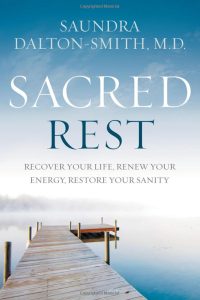
The book is Sacred Rest: Recover Your Life, Renew Your Energy, Restore Your Sanity. When did this book come out? Is it a couple of years ago already?
It came out a couple of years ago in the hardcover and audiobook version of it and then was re-released in the paperback version in 2019. When you were a guest on Dr. Oz, you were talking about rest. That was the reason you were there, right?
Is your research now begun to evolve? What's new on the horizon for you?
The biggest thing that I'm finding that people are having questions about and it's always been this case has been how do I know which of these seven is the one that I need most and I need to focus on. That's where the Rest Quiz came from. That's where the research is being extrapolated from with people taking the Rest Quiz and getting the results from there. It's as simple as RestQuiz.com. It takes about five or so minutes to do the quiz and then you get an email that tells you which of the seven you have the highest level in. You can focus your attention on getting more restorative activities in that 1 area or 2 but you don't have to try to get all seven because honestly, most of us are automatically getting some of these without even thinking about them. How nice it is to be conscious of it and aware of what you could be doing even more of when it's working. It’s good it's working if you don't know it's working but even better when you do know, “This is how I take care of myself.” I’m totally fascinated with this. Right before you were saying that, I go, “I hope she has a quiz, an assessment or something like that.” We have an assessment on our website as well. Those assessments especially when they're short, 3 to 5 minutes, you can gain so many insights from it when the questions and the processes set up well, which I absolutely believe would be in this case. I would like to end with one question to you, which is what's the one thing that you do on a ritual basis that you know is your go-to? If you got to pick one thing to develop your resilience for that day and you feel depleted in some area, what's the one thing you go to? The one thing I do every morning, the second I roll out of bed, I ask myself, “On a scale of 1 to 10, how energized do I feel?” Depending on what that number determines what I do that day because if I automatically feel like I'm at a five then I'm evaluating, “Where do I need to do restorative work?” I found for myself that I spent a long time working out of my emptiness. Although I can produce at that level, it is not my best work. I don't want to live like that. I want to live where I'm producing my best work. I evaluate and then I determine what needs to be worked on and then from there I determine where I am going to pour myself out of. I absolutely loved the way you describe that as working out of my emptiness. I haven't heard that language in quite that way before. Saundra, I appreciate you. Thank you for being a part of what we're doing here. A lot of people get tremendous value out of what you've shared with us and a tangible way to approach resilience. The rest component is something that we're often either told overtly or it's implied that we can just sleep a little less, do a little bit more with our days, be a little bit more productive and work a little harder. A lot of people talk that language out there into the space, “Start your side hustle at 7:00 at night and keep going until 1:00 AM or 2:00 AM and you'll be just fine. Get up and start the day over again. Work your day job and do your side hustle.” That is such dangerous advice to give to people because long-term, it isn't going to produce what will result in a life that’s healthy, peaceful, joyful, happy, balanced or whatever. A harmonious life does not come from that kind of excess and perpetuates that screaming, yelling fire in a crowded theater to me. I appreciate your perspective on all this. Thank you for being a guest on the show. Thank you. It's been a pleasure. I remind myself of the ritual that I use each day to wake up and be awake. It's three parts. First one, wake up. Two, in that waking moment. Isn't it true, Saundra? We don't have a guarantee if we go to sleep tonight that we're going to wake up tomorrow. I'm waking up. Isn’t it possible that the first thought you have could be gratitude for the fact that you are in fact opening your eyes for that day? Three is what are the words that come out of your mouth? I do believe we speak our lives into being and so much of what we experience in life is what we say we're going to experience. If you start out with your aches, pains, complaints and any number of other ways that you can start the day or with nothing in particular in mind, you have random things show up. For me, my experience when I start out my day in a definitive way, the way my grandmother would say, “Start out on the right foot.” The right foot is the right thought. What do I want to have come out of my mouth at the beginning? I gave a TED Talk about this one thing. It’s ‘I love my life’. That's it. Four words. Start the day, I always say that same thing.
I love that. You can try it tomorrow morning.
I will. All of you out there, you try anything out that you want and let us know what you love to say when you start your day. Let us know whether you've got some rest deficits and how this talk helped you because I know it was wonderful to be a part of it. I love to get your comments. Go to
AdamMarkel.com
/
podcast
to leave a comment and subscribe if you haven't. If you know somebody that could benefit from reading what's been shared here about rest and a lot of this other conversation, please share this episode with them. Let them know that we are here as well to support them. Thank you and have a beautiful blessed rest of your day.
You, too. Thank you.
Important links
TED Talk - DOING THIS for 10 Seconds Can Change Your Life!
About Dr. Saundra Dalton-Smith

Dr. Saundra Dalton-Smith is a Board-Certified internal medicine physician, speaker, and author. She is an international wellness expert featured in numerous media outlets including Prevention, MSNBC, Women’s Day, FOX, Fast Company, Psychology Today, INC, and as a guest on Dr. Oz show. She is the author of numerous books including her new book Sacred Rest: Recover Your Life, Renew Your Energy, Restore Your Sanity, including ground-breaking insight on the seven types of rest needed to optimize your productivity, increase your overall happiness, overcome burnout, and live your best life. Over 100,000 people have discovered their personal rest deficits using her free assessment at
RestQuiz.com. Learn more about Dr. Saundra at
IChooseMyBestLife.comand
DrDaltonSmith.com.
Build Momentum That Lasts
By combining practical frameworks with decades of experience, he transforms insight into systems that fuel growth, engagement, and long-term resilience.
Fresh Perspectives on Leadership & Performance







.png)
.png)
.png)